
by
Nitin Dubey
0 (0 Ratings)
Music Theory Simplified
Music theory often feels like a puzzle with a few too many pieces. ‘Music Theory Simplified’ offers a new perspective and turns ‘theory’ into something you can easily understand and practically apply. Created by a professional music composer, this approach focuses on most musicians’ search for the practically usable intermediate to advanced components of theory in the real world. With countless deconstructions and examples of popular Indian songs and without the jargon, this course is designed for anyone who loves popular Indian music and wants to learn more about music theory in an enjoyable way while starting from the basics.
[Captions and quizzes are being added to all courses and will be available soon]
What will I learn?
- The Physics of Sound: Understand the 12-note Equal Temperament system, the science of frequency and how it contrasts with Indian Classical tuning.
- Intervals & Intuition: Move beyond "semitone maths". Learn to identify intervals by their emotional quality, internalising the DNA of melody and harmony.
- Scales & Modes: Master the Major, Natural, Harmonic and Melodic Minor scales. Explore specific moods using Modes to expand your emotional palette beyond the standard box.
- Chord Architecture: Construct complex chords, from suspended chords to the tension of Diminished chords and lush Extensions (7ths, 9ths, 11ths).
- Functional Harmony: Understand why chords create tension and release. Master concepts like Secondary Dominants and Inversions to create smooth, professional voice leading.
- Cinematic Techniques: Learn the "dark arts" of composition, including Chromatic Mediant Modulation, Negative Harmony and how to distinguish between true Modulation and Borrowed Chords.
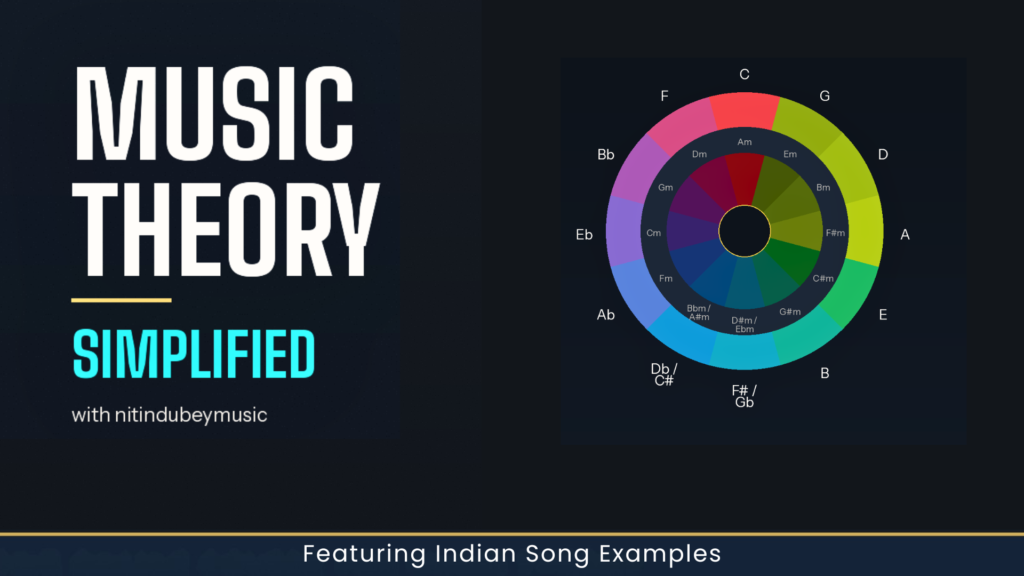
- The Circle of Fifths: Master this essential map to navigate key changes, calculate sharps/flats instantly and understand harmonic relationships for songwriting.
- The Energy Graph: Arrange tracks effectively by visualising dynamic curves. Learn to structure Verses, Choruses and Bridges to manage listener gratification and energy flow.
- Melodic Craft: Discover the strategies behind memorable melodies, utilising Motifs, Contour and phrasing.
- Texture & Counterpoint: Create rich, professional arrangements by layering independent melodic lines (Counterpoint) rather than just relying on block chords.
- Rhythm & Notation: Navigate complex Time Signatures (4/4, 6/8, 7/8), rhythmic subdivisions and gain a working knowledge of reading notes on the staff.
- Analyse the Hits: Modern Classics (Rehna Tu, Tamizha Tamizha / Bharat Humko, Roja, Airtel Tune, Dil Chahta Hai, Kaisi Hai Yeh Rut, Abhi Mujh Mein Kahin, O Re Piya) and Retro Gems (Nakhrewali and Tere Bina Jiya Jaye Na).
- Professional Case Studies: Step inside a working professional's studio. Explore the actual DAW sessions of original ad campaigns (including Cadbury and Good Knight) to see how a composer interprets briefs and crafts a complete narrative in 30 seconds.
- The Indian Context: A unique approach that connects Western Music Theory concepts to their Indian parallels, relating Major/Minor scales to Thaats and intervals to Shuddha/Komal Swaras, making complex theory intuitive for musicians with an Indian musical background.
- The Technical Foundation: Gain essential knowledge of Digital Audio (Sample Rates, Bit Depth, Quantisation) to ensure productions meet professional technical standards.
Course Curriculum
Music Theory Simplified
Music theory often feels like a puzzle with a few too many pieces. 'Music Theory Simplified' offers a new perspective and turns ‘theory’ into something you can easily understand and practically apply. Created by a professional music composer, this approach focuses on most musicians’ search for the practically usable intermediate to advanced components of theory in the real world. With countless deconstructions and examples of popular Indian songs and without the jargon, this course is designed for anyone who loves popular Indian music and wants to learn more about music theory in an enjoyable way while starting from the basics.
1. Why Music Theory
01:012. The Keyboard
02:333. The Tuning System and The Basics of Sound
02:404. Intervals
11:555. The Major Scale
13:276. Triads
15:277. Harmonizing a Scale
14:248. Intervals Continued with Song Examples
17:199. Natural Minors, Relative Minors and Parallel Minors
05:3310. Learning through Deconstruction – O Re Piya
01:4711. Harmonic Minor Scale and Suspended Chords
09:1912. Melodic Minors
03:2713. Learning Through Deconstruction – Functional Harmony and Tamizha Tamizha: Bharat Humko (Part 1)
29:3714. Extended Chords and Whole Tone Scale
04:5915. Learning through Deconstruction – Inversions and Nitin’s Cadbury Ad 1
13:3316. Functional Harmony in Minor Scales
06:5017. Modes
21:3818. Learning through Deconstruction – Dil Chahta Hai
26:4819. Learning through Deconstruction – Modulation and Rehna Tu
21:0120. Enharmonic Nomenclature
02:5021. Circle of Fifths – Sharps
12:0322. Pentatonic Sclaes, Blue Note and 12 Bar Blues
09:4323. Learning Through Deconstruction – Chromatic Mediant Modulation
29:2024. Learning Through Deconstruction – Extended Chords and Tamizha Tamizha: Bharat Humko (Part 2)
09:0925. Secondary Dominants
11:3926. Advanced Modes and Scales
07:2927. Circle of Fifths – Flats
06:3228. Initial thoughts on melody
05:1229. What Makes a Good Melody
22:5230. Diatonic Chords of the Harmonic Minor Scale
13:4631. Notes on the Staff
05:4032. Time Signatures and Rhythm
41:0133. Tone, Timbre, Texture and Counterpoint
09:5434. Cadence
16:4535. The Old Way of Naming Harmonic Inversions
01:5536. Half Cadence – More Examples
04:2837. Learning through Deconstruction – Nakhrewali
11:5838. Learning through Deconstruction – Nitin’s Cadbury Ad 2
15:1739. Advanced Modulation Trick
09:1840. Learning through Deconstruction – Abhi Mujh Mein Kahin
25:5541. Modulation vs Borrowed Chords
01:4542. When is a Relative Minor Movement a Modulation?
02:3143. How to Know Whether It Is a Modulation or Tonicization
00:4344. Triads vs Extensions
03:1545. Learning through Deconstruction – Nitin’s Good Knight Ad
23:0146. How to Get Inspired
10:2647. Random Thoughts
08:4148. Structure – The Energy Graph of a Song
10:4849. Negative Harmony
10:4850. Bonus Content – Audio Basics
11:25Music Theory Simplified – Session Notes
Student Ratings & Reviews

No Review Yet
Requirements
- I've designed this for complete beginners, but it goes deep. If you're comfortable with scales, intervals and triads, start at Chapter 8.
₹10,000
₹14,900
- LevelBeginner
- Total Enrolled126
- Duration9 hours 39 minutes
Hi, Welcome back!
Target Audience
- Whether you're just starting out or have been making music for years but feel your theory foundation has gaps, this course is for you. All you need is a keyboard and access to a DAW.
Material Includes
- Includes a 250+ page PDF with all presentation material from the course.
Share Course
Page Link
Share on social media